

Asphalt Over a Gravel Driveway: What Has to Happen First
AI Overview
You can seal a gravel driveway with asphalt, but almost never by laying it straight over the top. Most rural gravel around Launceston is tipped material, not engineered road base, so it has to be checked with test holes and a proof roll, then trimmed, topped up and re-compacted before anything is laid. On long rural runs, spray seal and staging the job over two seasons are often smarter answers than asphalting the lot at once.
Key Highlights
- →Tipped paddock gravel is a surface, not a base. Engineered road base is a different material
- →Test holes plus a proof roll tell you which sections can stay and which get dug out
- →Asphalt laid over gravel that still moves will rut in its first wet winter
- →Three real options: full rebuild, rework and overlay, or spray seal
- →Sealing changes where the water goes, so table drains and culverts come first
- →There is no kerb out there, so a compacted shoulder each side stops the edges crumbling
Plenty of properties around Launceston and the Tamar have a gravel driveway that has done its job for twenty years and is now a nuisance. Dust in summer, corrugations by autumn, and a grader bill every couple of years.
The obvious fix is to seal it. The question we get asked, almost word for word, is whether we can just run asphalt over the gravel that is already there.
Sometimes yes, usually not, and the difference is worth an hour of testing before anyone quotes a price. Here is how we work it out.
What your gravel driveway actually is
Most rural driveways out here were not built, they accumulated. Loads of quarry rubble, river gravel or crusher dust got tipped and spread over the years, on top of whatever soil was already sitting there. That is a surface, not a pavement, and the difference matters the moment you want to seal it.
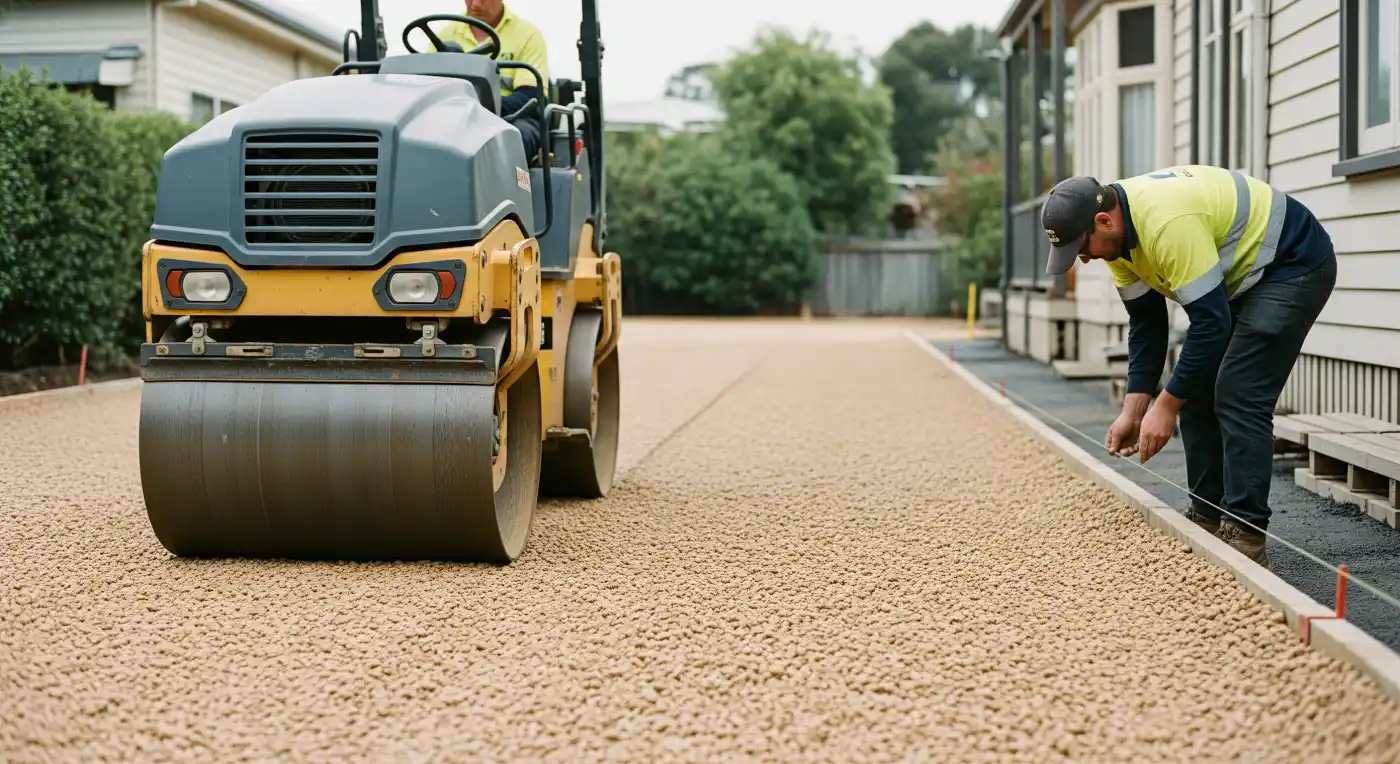
Engineered road base is a graded blend of rock sizes with sharp faces that lock together under a roller. Paddock gravel is often single sized, rounded, or loaded with fines that turn to mud in a wet week. It will carry a ute in January and still be useless as a base under asphalt.
Why laying asphalt straight over the top fails
Asphalt is a wearing course. It is thin, flexible and waterproof, and it does almost none of the structural work. Lay it on gravel that still moves and it moves with it.
The failure is predictable enough that we can usually pick the year. Ruts show in the wheel tracks through the first wet winter, then the ruts crack, then water gets into the cracks and starts taking the base out from underneath. By the third year you are paying to dig out and rebuild the thing you were trying not to rebuild.
The quote that should worry you
If a contractor prices asphalt over your gravel without digging a test hole or running a proof roll, they have not looked at what is under there. They have quoted the easy version of the job, and the hard version is the one that actually exists.

How we work out whether your gravel can stay
- Dig test holes along the run, deep enough to reach native soil, and record how thick the gravel really is at each one
- Look at what the gravel is: graded crushed rock with sharp faces is worth keeping, rounded river stone and crusher dust are not
- Proof roll the length with a loaded truck and watch for the surface pumping, rocking or leaving a rut behind the wheels
- Check the soil under it, because dispersive clay and permanently damp sections change the answer regardless of what is sitting on top
- Measure the shape, since a driveway crowned by years of grading has to be reshaped to a proper crossfall before it can be sealed
The honest outcome is nearly always mixed. Some of the run has enough sound material to be trimmed, topped up and compacted into a working base. The rest, normally the low wet stretches and the turning areas, needs digging out and building properly.
The three real options, not two
| Option | What happens | Best suited to |
|---|---|---|
| Full rebuild | Existing gravel is stripped or dug out, sub-base is built to spec and compacted in lifts, asphalt laid over it | Short and medium runs, and anywhere you want the driveway to behave like a road |
| Rework and overlay | Gravel is tested, trimmed, topped with fresh road base, re-compacted, then asphalted | Runs where the test holes show sound graded material at a usable depth |
| Spray seal | Two coats of bitumen with aggregate rolled into it, over a prepared and compacted gravel base | Long rural runs where cost per metre matters more than a dense smooth finish |
Spray seal, the same two coat treatment councils use on rural back roads, deserves a proper conversation on a long driveway. It kills the dust, stops the corrugations and covers far more metres for the money than asphalt does. It is louder underfoot, it throws loose stone for the first few weeks, and it will never give you the dense black finish most people picture when they say sealed.
The length problem nobody mentions on the first call
A suburban driveway is a day or two of work. A long farm entrance is a different kind of job and the cost does not scale the way people expect. Base material, cartage and compaction time all multiply, and paver access has to be sorted for every metre of it.
Staging is the sensible answer far more often than people expect. Seal the stretch that does the most damage to cars and gets the most traffic, usually the last run into the house plus the turning area, and keep the back half as maintained gravel. It is a normal way to do it out here.
The question is rarely whether it can be sealed. It is how many metres are worth sealing this year.

Drainage decides whether it lasts
On a rural run there is no kerb and no stormwater pit waiting to catch what comes off the surface. Water has to be shed sideways into a table drain and carried under the driveway by a culvert wherever it needs to cross.
Sealing a driveway changes the water. Gravel soaks up a fair share of the rain, a sealed surface sends all of it somewhere, and if that somewhere is the shoulder or the base then the new surface quietly undoes itself. Drains, culverts and a consistent crossfall are part of the job, not an optional extra.
Fix the water before you fix the surface
If the driveway holds water anywhere after heavy rain, sort that out first and watch it through one proper wet spell. Sealing over a spot that ponds only hides the problem until it comes back up through the asphalt.
Edges, because there is no kerb out there
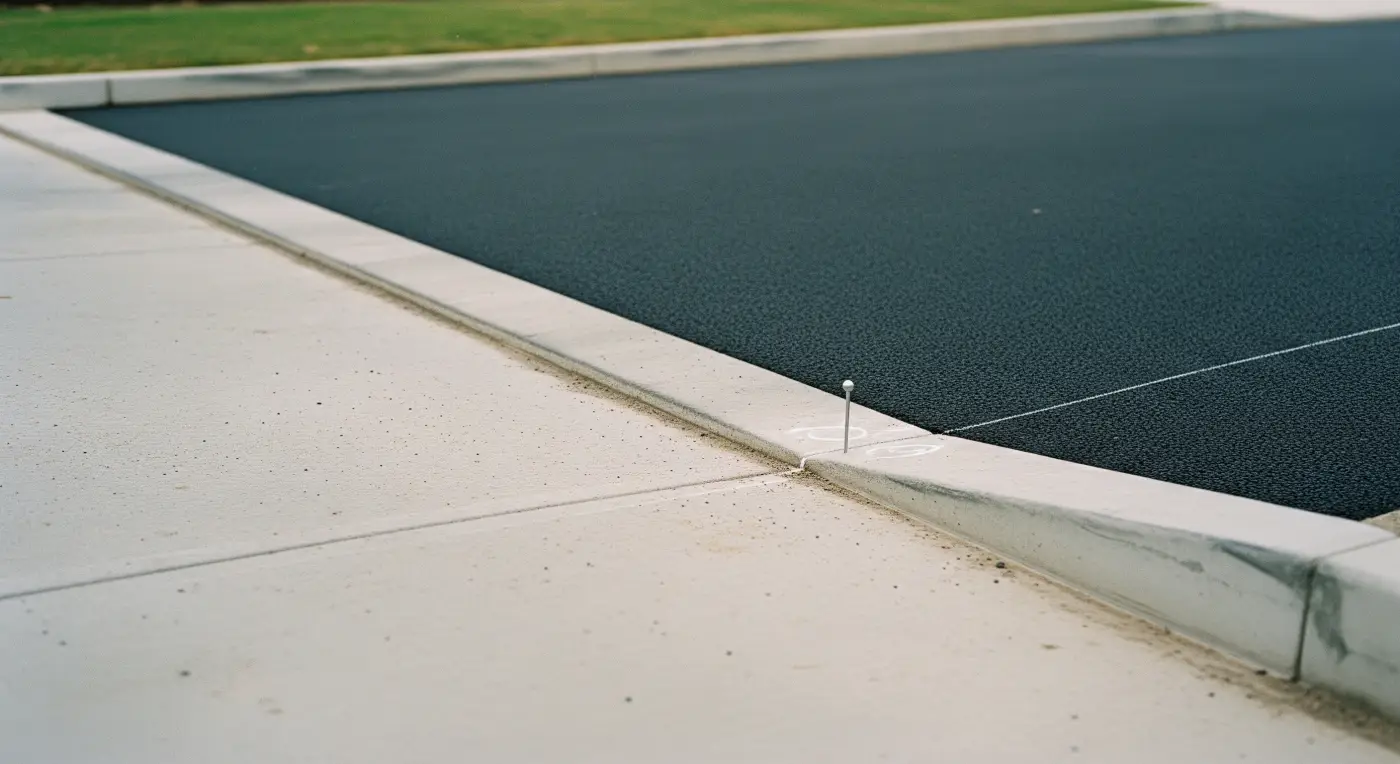
In town the asphalt is held in by concrete kerb or a path. On a rural driveway the edge is unsupported, and an unsupported asphalt edge crumbles under the first wheel that runs off it.
The fix is a compacted shoulder of the same base material, built wider than the asphalt on both sides and graded away toward the drain. Timber or concrete edging works well on the shorter approaches near the house. Whatever it is, budget for it, because it is the first thing quietly dropped from a cheap quote.
Where your driveway meets the road
The piece between your boundary and the road is the crossover, and it belongs to council rather than to you. Sealing a long private driveway does not automatically give you the right to seal or widen that section. If your entrance is gravel where it meets a sealed road, expect council to have a view on it and to want an application first.
Timing it in northern Tasmania
Asphalt needs a base dry enough and warm enough to bond and compact properly, which rules out a good deal of a Tasmanian winter. The usable window sits across the warmer months and it books out early. Base work can happen sooner, and often should, because a rebuilt base that sits through a wet spell and stays flat has proved itself before a cent of asphalt goes on it.
Questions worth asking before you sign anything
- How many test holes did you dig, and what depth of gravel did you find in each?
- Which sections are you reusing and which ones are you digging out?
- What is going in as base material, at what depth, and how many compaction lifts?
- What happens to the table drains, and are any culverts being replaced?
- How wide is the compacted shoulder either side of the finished asphalt?
- If we staged this over two seasons, where would you stop the first stage?
FAQ
Common questions
Can asphalt be laid straight over a gravel driveway?+
Only when the gravel underneath is genuinely engineered road base, at the right depth, properly compacted, correctly shaped and draining. That is uncommon on a driveway that grew out of tipped loads over twenty years. Test holes and a proof roll tell you which situation you are in, and finding out takes about an hour.
Is spray seal the same thing as asphalt?+
No. Spray seal is bitumen sprayed onto a prepared base with aggregate rolled into it, so the stone you can see is the surface. Asphalt is a manufactured mix laid hot and compacted into a dense mat. Asphalt is smoother and stronger, spray seal covers far more metres for the same money.
Will sealing the driveway get rid of the dust?+
For the sealed section, yes, and that is usually where most of the dust comes from. Any unsealed stretch left at the far end will still generate dust, and traffic carries some of it onto the sealed part.
Do I need council approval to seal my own driveway?+
The private section on your own land generally does not. The crossover between your boundary and the road does, and widening or reshaping a rural entrance normally needs an application to the relevant council before the work starts.
Can the job be done in stages?+
Yes, and on a long run it usually should be. The one thing to plan properly is a clean, well formed join at each stage boundary, so the finished surface does not step or crack along the seam when you come back to do the rest.
KEEP READING
More from the crew
Got a job? Get a quote.
Free site visit, real prices, quote in writing within 48 hours.