
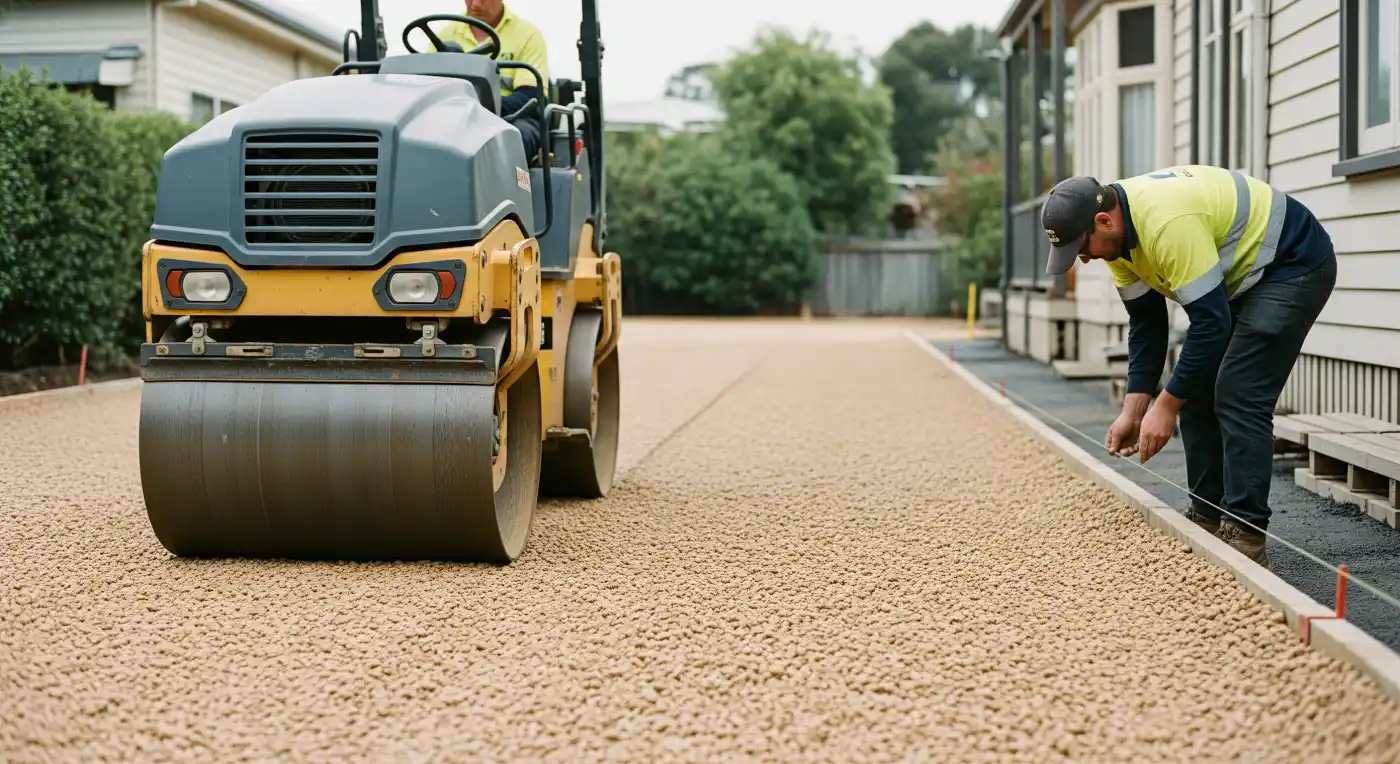
Sub-Base: The Most Important Part of a Driveway You'll Never See
AI Overview
The sub-base under your asphalt driveway is the layer of compacted crushed road-base (typically 150-200mm thick) that does 90% of the structural work. The asphalt on top is essentially a waterproof wearing layer, the sub-base carries the actual vehicle load. Cheap or shallow base prep is the single biggest cause of driveway failure in the first 5-10 years. This guide explains what good sub-base looks like, why it matters, and the warning signs of bad base work.
Key Highlights
- →Sub-base does 90% of the structural work on a driveway
- →Standard residential: 150mm compacted road-base; ute/commercial: 175-200mm
- →Compaction to 95% MMDD (Modified Maximum Dry Density) is the spec
- →Cheap base prep = driveway fails in 5 years instead of 25
- →Edge restraint matters as much as depth — needs 50mm wider footprint than the asphalt
- →On dispersive clay (Scottsdale, eastern George Town), add geotextile separation layer
The asphalt you see on a driveway is the wearing course. It's about 30-50mm thick and its job is to be smooth, waterproof, and look good. The structural work happens below it, in the sub-base.
Most asphalt failures in Launceston aren't asphalt failures, they're base failures. The asphalt cracks because the layer underneath has moved. That's why a good contractor spends more time talking about base prep than asphalt type.
This guide walks through what a properly built sub-base looks like, what cuts it short, and how to spot the warning signs that yours wasn't done right.
What sub-base actually is
Sub-base is a layer of crushed quarried rock (in Tasmania, usually local dolerite or sandstone fines, abbreviated 'FCR' for fine crushed rock) that sits between your native soil and the asphalt above. It's mechanically compacted to about 95% of its maximum density, creating a stable platform that distributes vehicle weight across the soil below.
The thickness depends on what's going on it. A 150mm layer is standard residential. Add 25mm for a property that gets regular ute traffic. 200mm minimum for commercial carparks.
Why compaction matters
Loose road-base just gets compressed by the first heavy vehicle that drives over it, creating ruts. Properly compacted base, run over with a vibrating roller in 75mm layers (called lifts), reaches the spec density of 95% MMDD and stops moving.
If you ever see a contractor pour road-base and then immediately lay asphalt without rolling, walk away from that job. The compaction has to happen in lifts, not in one pass.
The signs of a good sub-base
- After laying, the surface is dead flat — no soft spots underfoot
- After 6 months, no rutting visible where vehicles park or turn
- After heavy rain, water sheets off and doesn't pool
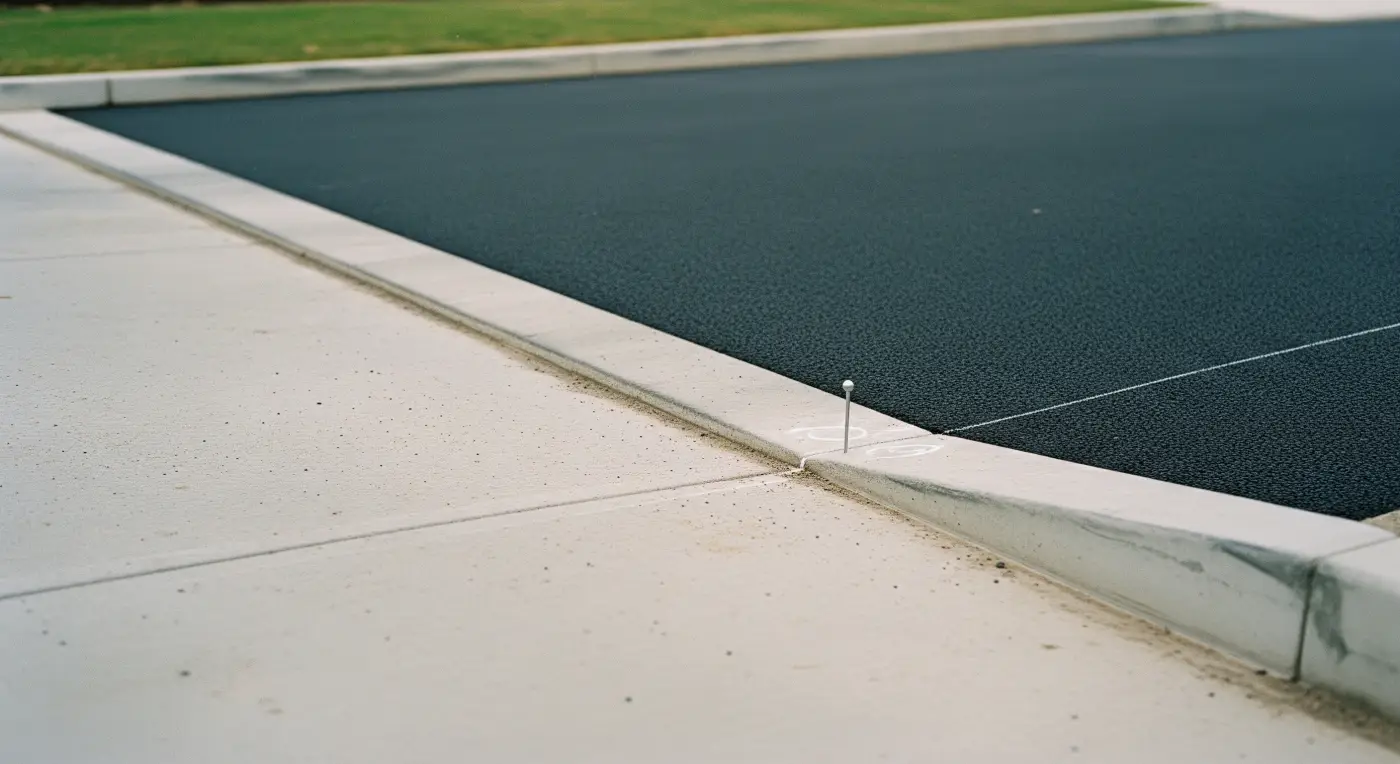
- After 12 months, no cracks at the joints between the driveway and concrete kerb/path
- After 5 years, no edge crumbling — the asphalt edges stay sharp
The signs your sub-base was done poorly
Watch for these in the first 12 months
Rutting in tyre-track areas, depressions where the asphalt has settled, cracks that follow the line of where utility trenches were filled, water pooling on the surface — all of these are sub-base problems showing up through the asphalt.
Special cases: dispersive clay and reactive soils
Some Tasmanian sites have what's called dispersive clay subsoil — a soil type that breaks down when wet and re-forms when dry. Common east of George Town and around Scottsdale on the mudstone subsoil.
On dispersive soils, a standard 150mm sub-base isn't enough. The fine particles of the clay migrate up into the road-base over time, contaminating it and weakening the structure. The fix is a geotextile separation layer between the subgrade and the road-base, plus a deeper sub-base (200mm minimum).
Edge restraint, the other half of the equation
Sub-base depth gets the headlines but edge restraint is just as critical. The asphalt edges need to be supported from the side or they crumble in 5 years. Good base prep extends 50mm wider than the asphalt above and includes either a concrete kerb, a hardwood timber edge, or compacted shoulder material.
What to ask your contractor at quote time
- What depth of sub-base are you specifying?
- How many compaction lifts will you do?
- What's the spec material — crushed road-base, recycled, or subgrade-only?
- Do I need a geotextile separation layer here?
- What's the edge restraint detail?
FAQ
Common questions
Can I save money by using less sub-base?+
Yes, and it will cost you 3x as much in 5 years when the driveway has to be re-done. We've seen it more times than we can count. The cheapest part of a driveway job is the base material; the most expensive part is replacing a failed driveway because the base was undersized.
Is recycled crushed concrete a good substitute for road-base?+
For light residential it's fine and saves money. For commercial or anywhere that ute axle loads will travel, stick to virgin crushed road-base. Recycled material has more variability in particle size and compaction performance.
How do I know if my existing driveway has good base?+
Walk it after heavy rain. Pooling water = bad falls or poor compaction. Tyre-line ruts after 2-3 years = insufficient depth. Edge crumbling = no edge restraint. If you see any of those, the base wasn't done properly.
Can sub-base be re-used when re-doing a driveway?+
Sometimes. If the existing sub-base is sound (no migration of fines, no contamination, correct depth), it can be re-rolled and topped with new asphalt. This is called a 'strip-and-relay' and saves money. If the base is compromised, it has to be dug out and replaced.

Got a job? Get a quote.
Free site visit, real prices, quote in writing within 48 hours.